

What the school safety plan covers
Since 2024, the French school safety plan, the PPMS, has been a single document. It covers major hazards, including flooding, as well as attacks and intrusions. Two drills are planned every year.
Depending on the situation, the school’s management or the authorities choose a response: sheltering, reinforced sheltering or evacuation. For a flood, the authorities may organise a preventive evacuation if time allows.
Under an orange warning: prepare without waiting for the alert
An orange warning signals a risk, not yet a flood. This is the time to check the plan without worrying the pupils. Météo-France, the French weather service, then advises limiting travel and taking shelter in a solid building.
19
schools closed in Upper Corsica on 5 November
2
safety drills planned every year
350
households without power the same day
- Go over the sheltering area with the team, upstairs if the building is exposed.
- Check the safety kits: torches, battery radio, pupil lists, water.
- Choose the person who follows instructions from the prefecture and the town hall.
- Prepare the message to families, to be sent through the school’s usual channel.
On the day of the alert: a short instruction
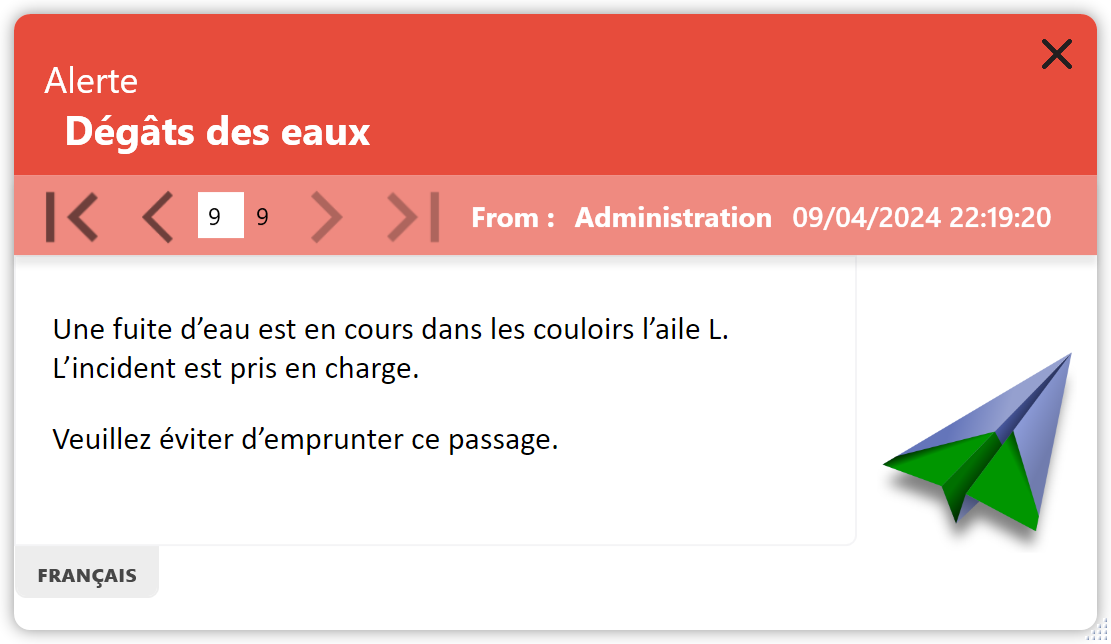
The alert message must fit in a few lines : the chosen response, the place, what to take. Teachers read it out to their class.
Send it to the school’s PCs: classrooms, pastoral office, reception, offices. A classroom PC often stays on for the projector. dMessage displays the instruction on top of everything else, with a read receipt to spot a classroom that has not seen the message.
Keep a backup that does not depend on the network: a bell, walkie-talkies, or an adult who goes along the corridors. Heavy rain also causes power cuts: in Upper Corsica, 350 households lost power on 5 November.
Avoid
Sending the instruction by email only. In class, nobody reads their email.
Good habit
During an orange warning, check that the PC in each classroom is switched on and connected to the network.
Families and the all-clear
Under a red rain and flood warning, Météo-France advises parents not to collect their children from school. Prepare this message to families in advance: it prevents dangerous journeys.
The all-clear also deserves a message. It says whether lessons resume normally, whether some rooms stay closed, and what time pupils leave.
Test it during the drill
The safety drill is a chance to check the whole chain: sending the instruction, reading it in each room, returning the registers. Note the rooms that did not get the message and fix this before the next episode.
The Poitiers education authority uses dMessage
Test the safety instruction in your classrooms before the next drill
The trial version is free for 30 days. Install it on a few classroom PCs and see who has read the message.
Plan a school safety drill on Windows PCs · Tell staff about a closure due to bad weather
Sources: Upper Corsica prefecture · franceinfo · Météo-France, orange warning advice · PPMS template guidance, Éduscol