

Where the timetable stands
- The French Senate adopted the bill on 12 March 2025.
- The National Assembly debated it in plenary from 9 November 2026. The formal vote is scheduled for 17 November.
- A joint committee of both houses will probably have to reconcile the two versions. Enactment and the implementing decrees will follow.
- The decrees will set the thresholds, the list of entities and the reporting procedures. Until they are published, the new obligations do not apply.
ANSSI, the French cybersecurity agency, will be the national authority. It sums up the obligations in three verbs: register, protect, report. Local authorities are also within scope, according to thresholds set by decree.
Reporting fast means knowing fast
The NIS2 directive requires an early warning within 24 hours, an incident notification within 72 hours and a final report within one month. A personal data breach must also be notified to the French data protection authority, the CNIL, within 72 hours under the GDPR.
24 h
for the early warning
72 h
for the incident notification
1 month
for the final report
These deadlines can only be met if information flows up without delay. A member of staff who sees a ransom note, a technician who spots an anomaly: everyone must know whom to warn. Internal communication therefore starts before the incident.
Three messages to prepare
An incident unfolds in stages. Prepare a template for each one, approved by management and the security officer.
- The first alert. It says what to do right now: do not open attachments, do not restart your PC, call a specific number.
- The progress update. It lists the affected services, what still works and the time of the next update.
- The recovery. It explains what comes back, in what order, and what to do when restarting.
Common mistake
Preparing the notification to ANSSI but not the message to staff. Without an instruction, a colleague may open the same attachment an hour later.
Keep a record of what was said
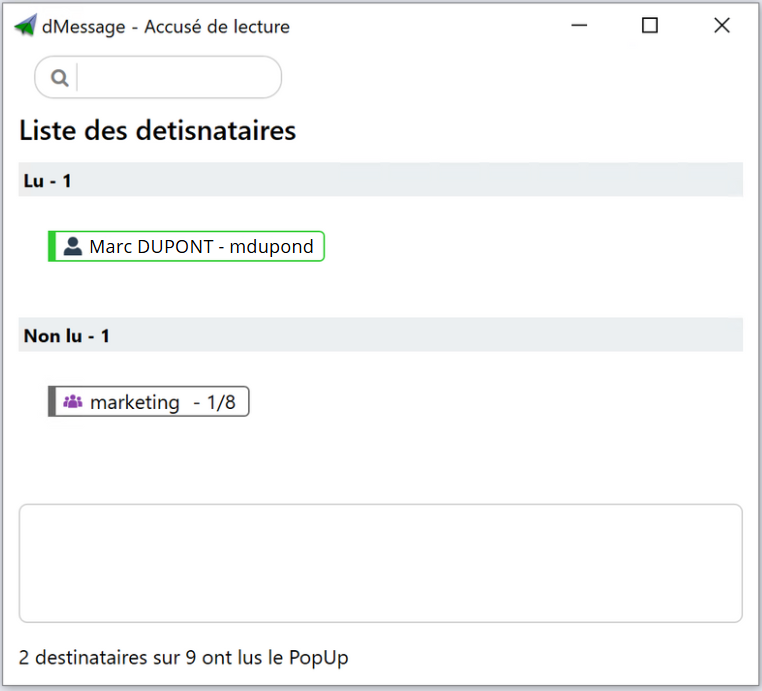
If audited, the organisation will have to show how it handled the incident. Record the time of each message, its content and the teams it targeted. A read receipt also shows who saw the instruction, and whom to follow up with.
dMessage records this information for every message sent. It runs on the local network without any cloud service, so it stays available if email is affected, as long as the internal network works.
Who does what during the incident
- Crisis unit. It decides on the messages and how often to send them.
- Security officer. They prepare the early warning and the incident notification.
- Data protection officer. They assess the impact on personal data and the notification to the CNIL.
- Managers. They pass the instructions on to people without a PC or who are away.
Test this chain during a drill, before the decrees set the obligations. When the day comes, the templates and the list of recipients will be ready.
Safran and Amundi use dMessage
Keep a record of every instruction, from the first incident
With the trial version, prepare your three templates and check the read receipts after a drill. Free for 30 days.
Structure your IT crisis communication · Instructions for staff after a cyberattack at the town hall
Sources: Leto, NIS 2 transposition in France · Cyberini, NIS2 and the Resilience Act · Directive (EU) 2022/2555